

Most winter coats ask you to choose: warm enough to survive the commute, or sharp enough to wear somewhere that matters. The Rynvor Adventurer black leather longline jacket refuses the trade-off. It is cut long, lined end to end in soft faux fur, and finished in a coated that holds its shape through a full season of real wear — the kind of coat you reach for without thinking, from October through February.
What follows is everything worth knowing before you buy it: how the jacket is built, what the fabric actually does in cold weather, how a longline silhouette should fit, five outfits that work with it, and the care routine that keeps faux leather looking new instead of tired. If you already know you want one, the Adventurer jacket page has the size chart and stock; the rest of this guide is about getting the most out of it.
Why a longline coat earns its place in a winter wardrobe
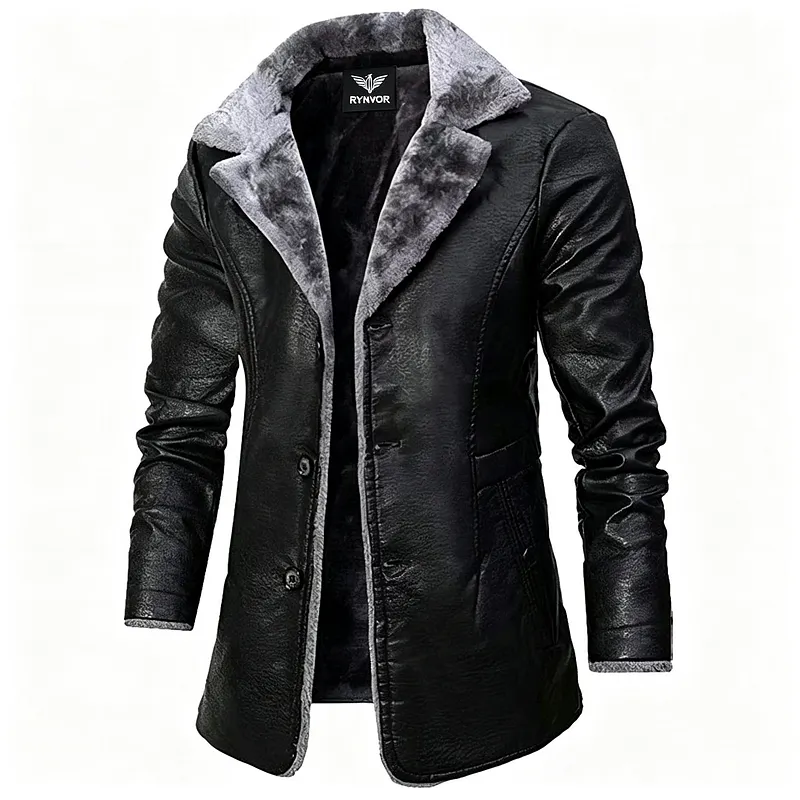
A hip-length jacket keeps your torso warm and leaves everything below it to your jeans. A longline coat covers the part of the body that loses heat fastest — the hips, the seat, the tops of the thighs — which is exactly where a cold wind does its damage on a walk to the station or a wait for a ride. That extra 20 to 30 cm of coverage changes how cold a 5 °C evening actually feels.
There is a styling argument too. Long outerwear draws one continuous vertical line from shoulder to mid-thigh, which reads as taller and leaner than the same body in a cropped bomber. It is the single easiest proportion trick in menswear, and it costs nothing but choosing the longer cut.
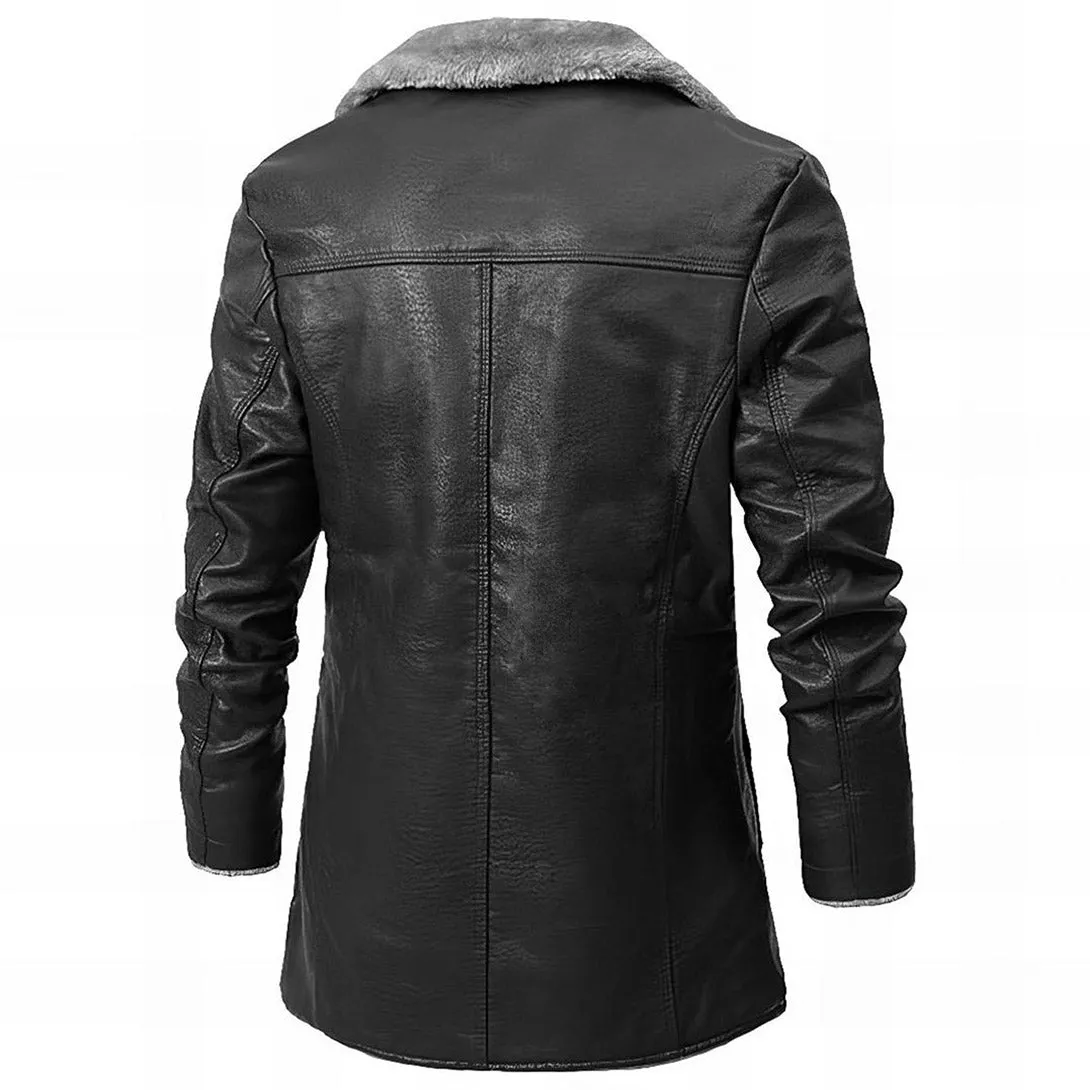
The reason more men don't own one is that longline outerwear is unforgiving of bad construction: if the shoulder is soft or the fabric is thin, the whole length collapses into something shapeless. The Adventurer solves that with a structured shoulder, a clean notch lapel, and a coated shell with enough body to hold its line — which is the point where a long coat stops looking like a bathrobe and starts looking tailored.
Anatomy of the Adventurer
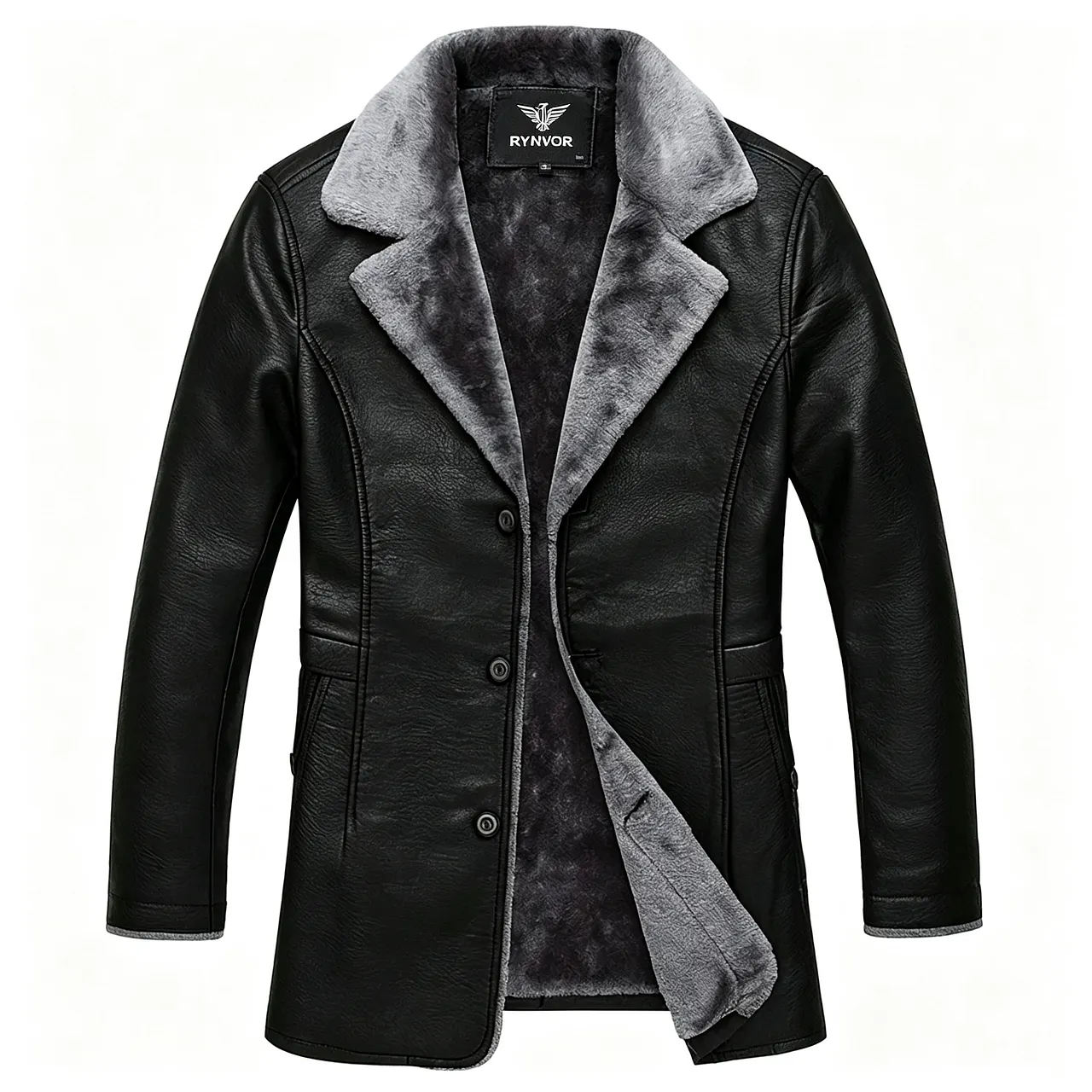
Strip away the marketing language and this is a single-breasted, three-button coat with a notched lapel, hip welt pockets, and a hem that lands around mid-thigh. The details that matter:
- Longline cut — extended coverage across the hips and thigh, with a hem that keeps its shape instead of curling.
- Notch lapel — the one bit of tailoring on an otherwise rugged jacket. It is what lets the coat work over a shirt and chinos as easily as over a hoodie.
- Full-length lining — not just a fur collar. The interior is lined through the body and sleeves, so warmth doesn't stop at the chest.
- Protective finish — the coating is water-resistant, scratch-resistant and abrasion-resistant, which is the difference between a jacket that survives a winter and one that shows every scrape.
- Two colourways — Black, which is the version most people want, and a Brown that suits warmer palettes and tan boots.
Faux leather, honestly
Let's be direct about the material, because this is where most product pages get vague. The Adventurer is not animal leather. It is a premium coated PU — a polyurethane surface bonded to a textile backing — and it is sold as exactly that: a cruelty-free alternative to leather, not a leather jacket in disguise.
What you gain by going PU is consistency and easy ownership. The grain is even, the colour doesn't fade unevenly across panels, and the jacket does not need conditioning, oiling or a specialist cleaner to stay presentable. It also doesn't develop a patina, which some people love about real leather and others find stressful — no guilt about the first scratch, no sentence of "it will look better in two years".
What the coating does well is the practical stuff. Water beads and rolls instead of soaking in, so a drizzle on the walk to work doesn't leave you damp for the rest of the morning. The surface resists abrasion at the places that wear first — cuffs, elbows, the edge of a bag strap — and it wipes clean, which matters if you commute by train or bike.
What PU is not: a raincoat, or a substitute for a down parka in genuine sub-zero conditions. Treat it as a wind-blocking, water-resistant, insulating shell — which, layered correctly, is exactly what a city winter asks for.
The lining is the real story
Faux fur gets marketed so heavily that it's easy to dismiss. Ignore the styling photos for a second and think about physics: a jacket keeps you warm by trapping a layer of still air against your body. A plush, high-pile lining does that far more effectively than a smooth polyester taffeta, because the fibres hold air instead of letting it slide away.
That is why the Adventurer feels warm the moment you put it on, rather than after ten minutes of walking. The fur runs the full length of the interior — body and sleeves — so your arms aren't the cold part of the outfit, and the fur-faced collar sits against your neck instead of a stiff seam.
It also changes how you layer. With most leather-style jackets you need a heavy sweater underneath to stay comfortable. Here, a merino crewneck or a mid-weight flannel is usually enough, which keeps the silhouette clean instead of bulky. Save the chunky cable knit for days when the temperature drops below freezing.
Fit: how a longline coat should actually sit
Long coats fail on fit more visibly than short ones, because every centimetre of error has more length to travel. Four checkpoints, in order of importance:
1. Shoulder. The seam should sit at the edge of your shoulder, not past it. A dropped shoulder seam on a long coat reads as borrowed clothing.
2. Chest. Button all three and you should be able to slide a flat hand between the coat and your chest — room for one mid-layer, no more.
3. Sleeve. The cuff should reach the wrist bone, or just below. Longline coats look better with a slightly longer sleeve than a cropped one.
4. Hem. Mid-thigh is the sweet spot for most heights. Much shorter and it loses the proportion benefit; past the knee and it starts to look like a costume.
If you are between sizes, take the larger one. Faux leather does not stretch the way animal hide does, and a long coat needs clearance at the shoulder to hang cleanly. Plan for the layers you'll actually wear: if you intend to put a heavy knit under it, size up; if it will mostly go over a shirt, take your normal size.
The most reliable method is to measure rather than guess — chest around the fullest point, shoulder seam to shoulder seam across the back, sleeve from seam to wrist, and the length you want from the base of the neck. Compare those four numbers against the size chart on the product page. If you're still unsure, email support@rynvor.com with your height, weight, chest measurement and usual jacket size, and ask for a recommendation. It's a two-minute email that saves a return.
Five outfits that work with it
The coat is a neutral, which means the outfits are about proportion and texture rather than colour matching. All five below assume the black version.
1. The default: charcoal knit, black jeans, Chelsea boots
A fine-gauge charcoal crewneck, black or dark indigo straight jeans, and a plain leather Chelsea boot. The coat does the work; everything under it stays quiet. This is the outfit that makes the jacket look expensive, and it takes under a minute to assemble. Keep the knit thin — the fur lining is already doing the insulation.
2. Smart-casual: Oxford shirt, chinos, loafers
This is the notch lapel's moment. A pale blue or ecru Oxford button-down, stone or olive chinos, and a penny loafer or a clean derby. Because the lapel is tailored rather than a biker collar, the coat reads formal enough for a dinner or an office with a relaxed dress code. Tuck the shirt, add a belt that matches the shoes.
3. Weekend: hoodie, cargo trousers, chunky sneakers
Grey or black hoodie, tapered cargos, and a substantial sneaker. The trick is to keep the hoodie short enough that it doesn't poke out below the coat hem — if it does, tuck it or pick a cropped fit. Wearing the coat open with hands in the welt pockets is the whole point of this look.
4. Monochrome: all black, one textural contrast
Black coat, black knit, black trousers, black boots — and let texture do the separating. A ribbed knit against the grained shell, a matte wool trouser against the coated finish. All-black only looks flat when every piece has the same surface; mix rib, grain, and matte and it reads deliberate.
5. Cold snap: cable knit, wool trousers, leather boots
Below freezing, you want the chunky layer — and this is where you need the size-up. An oatmeal or cream cable knit under the black shell is the most photogenic combination in the whole guide, and it's the reason the jacket was cut with a little room at the chest.
Shoes, bags, and the small decisions
Footwear sets the register. Leather boots — Chelsea, lace-up, or a hiking-derived silhouette — keep the coat looking intentional. Running shoes pull it toward athleisure, which is fine if the rest of the outfit agrees. A minimal white sneaker is the safe middle ground.
Bags matter more than people expect with a coated shell. A structured leather messenger or a canvas tote sits well; a hard-edged nylon backpack strap across the chest will eventually leave a sheen on the surface where it rubs. Carry it on one shoulder, or keep the strap short.
Scarf optional. The fur collar already frames the neck, and a heavy scarf on top of it tends to bunch. If you run cold, a thin merino scarf tucked inside the lapel works better than a thick wool one worn outside.
A weather playbook for the season
Commuting. This is the coat's natural habitat: standing on a platform in wind, walking ten minutes in light rain, then sitting in an overheated office. Unbutton it indoors; the fur lining traps heat fast and you'll overheat otherwise.
Weekends and evenings. Worn open over a knit, it's relaxed enough for a Saturday and sharp enough for dinner. The longline shape photographs well — worth knowing if you're the one taking the pictures.
Travel. A long coat is the single best piece to wear on a plane in cold months: it's bulky enough to skip packing, warm enough for a cold arrival, and structured enough to look presentable straight off a flight. Hang it rather than folding it into a bag.
Care: keeping faux leather looking new
PU is low-maintenance, but it is not indestructible. The rules are short and worth following.
Do wipe the surface with a soft, slightly damp cloth — plain water is enough for dust and road salt.
Do use a drop of mild soap on a damp cloth for a mark, then wipe again with clean water and pat dry.
Do hang it on a wide, padded hanger so the shoulders keep their shape.
Do let it air-dry at room temperature if it gets wet, away from radiators and direct sun.
Do store it in a breathable cotton garment bag at the end of the season, with a little air around it.
Don't machine wash, tumble dry, or soak it. Water inside the lining is hard to get out and can distort the shell.
Don't dry-clean it with standard solvent processes — the chemicals attack polyurethane and can make the surface go tacky or crack.
Don't iron it directly. If creases bother you, hang it in a steamy bathroom for fifteen minutes and let it fall out.
Don't leave it in a hot car boot, next to a heater, or folded under other coats for months.
Don't spray perfume or solvent near the surface, and keep hand sanitiser away from the cuffs — alcohol is one of the few things that will visibly damage a PU coating.
Skip leather conditioner and oils entirely. They are formulated for animal hide and will sit on top of a coated surface, leaving a greasy film that collects dust. A wipe-down at the end of each cold season is genuinely all this jacket needs.
Questions people ask before buying
Is this a real leather jacket?
No. It's a premium coated PU faux leather — deliberately cruelty-free, with a leather-like grain. It won't patina or age like animal hide, and it doesn't need the upkeep either.
Is it warm enough for a real winter?
For cool-to-cold city winters, yes — the full faux-fur lining does most of the work. In sustained sub-zero temperatures, add a heavy knit underneath and a scarf; it's an insulating shell, not a parka.
Can I wear a thick sweater under it?
Yes, if you size up. Take the larger size when your measurements sit between two, or when you plan to layer a cable knit or hoodie.
Will it keep me dry in the rain?
Light rain, yes — water beads off the coating. It isn't a raincoat, so for a long downpour carry an umbrella rather than relying on it.
Does it come in other colours?
Yes, Black and Brown, in sizes S through 4XL. The Brown version pairs especially well with tan boots and warmer neutrals.
What if the size is wrong?
Check the size chart on the product page first, and email support@rynvor.com if you're between sizes — they'll help you map your measurements before you order. Returns and exchanges follow the store's standard policy, listed on the product page.
The short version
A longline coat is the most useful outerwear upgrade most men never make, and the Adventurer is an unusually easy entry point: structured enough to look tailored, lined well enough to be genuinely warm, and finished in a shell that shrugs off winter instead of absorbing it. Wear it over a thin knit for most days, size up for the cold snap, keep it away from solvents, and it will look the same in February as it does in November.
Rynvor — outerwear built for cold cities. Questions about fit, sizing or care: support@rynvor.com